

Aug
14
Find your method
Filed Under Books, Broderie perse, Designers, Fusible web, Glue stick, Hand appliqué, Machine appliqué, Patterns, Prepared edge, Raw edge, Starch, Turned edge | 2 Comments
I’ve long been an advocate of finding your own method of appliqué, one that’s right for you and gives you results you like. That’s not the same for everyone, and I believe there’s no right and no wrong way, only what pleases you. When quilters stop by my booth at shows and make faces at the “A” word, I tell them they just haven’t found their method.
So I was delighted to take note of a new book by Laurel Anderson called Appliqué Workshop: Mix and Match 10 Techniques to Unlock Your Creativity!

Here’s some information straight from the author herself.
Laurel Anderson:
I wrote this book with the idea that everyone has different design needs and different technique requirements.
The quilter who wants to occupy her time while on a fishing boat or in a doctor’s waiting room will be more interested in hand appliqué or cutting out fused shapes for three-dimensional or fused appliqué. The mother of four with limited time may be delighted with the speed of machine appliqué or the raw-edge technique. The artist who wants creative freedom may mix many methods into one piece of fiber art.
The techniques in the book are grouped into turned-edge, raw-edge and needle-turn appliqué. Each technique has a summery of its best uses. For instance: the Turned Edge with Starch or Glue makes very sharp points on leaves or petals. The 3D Broderie Perse method makes fast and easy daisy petal shapes for wall hangings. It is easier to be creative if you have your choice of many design tools.
 Coneflowers by Laurel Anderson |
The book offers ten appliqué methods, two edge-finishing facings, and several different template ideas. As a bonus, there’s a section on color and a chapter on dying fabric for flower quilts. The pullout section gives six full-size, ready-to-use patterns. The instructions teach several techniques for each pattern. If you make them all you will have tried all the techniques!
The book is available from Laurel’s website, Whisper Color. Laurel says to be sure to send her a message in an email telling her who to sign to book to. (There’s a Contact button on the website.) And while you’re on the site, check out the 100% bamboo batting and Laurel’s latest stand-alone pattern, Winter Amaryllis.
 Winter Amaryllis pattern | Isn’t this gorgeous? |
Thank you, Laurel, for telling us about your exciting new book. I’ll be directing those face-makers to it!!
Until next time,
Kay
By Kay Mackenzie
Jun
18
Spotlight on Cheryl Almgren Taylor
Filed Under Blanket stitch, Fusible web, Machine appliqué, Patterns, Spotlights, Threads | 13 Comments
I’m delighted today to turn the blog over to appliqué author, designer, and teacher Cheryl Almgren Taylor.

Cheryl Almgren Taylor
Cheryl: I am excited to be a guest on Kay’s site today and want to thank her for the invitation to be a part of her blog.
I have loved quilts since I was a small child but never ventured into quilting until 2000. I had been sewing since I was 13 so I had some basic skills down. But I discovered, like many of us, that quilting is a whole new world.
I got into designing because of my grandson Michael and my love of storybooks. I spent 14 years teaching in the elementary grades and loved “read aloud” time with the kids. Several years ago I wanted to make Michael a quilt that would go with his favorite story Going On a Bear Hunt, and this led to the creation of a whole series of quilts that coordinate with childrens’ books. I was surprised and delighted when Martingale & Company (That Patchwork Place) chose to publish my designs in a pattern series entitled Storybook Snugglers.
There were six patterns in this original pattern series from 2007, with two quilt designs in each pattern–one easier version and one more detailed. There are still some patterns available from Martingale.

Monkey Business by Cheryl Almgren Taylor
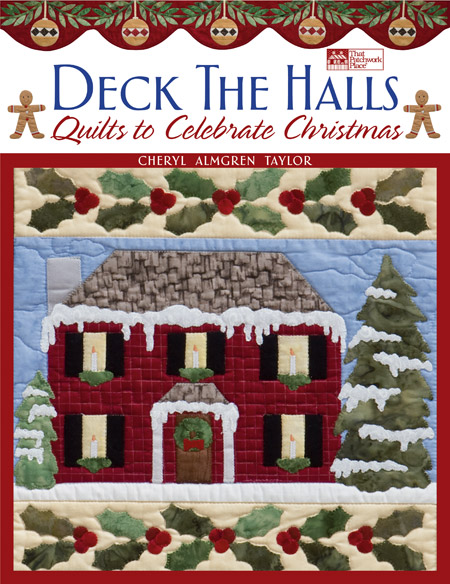
Last summer my first book Deck the Halls was published featuring a collection of Christmas quilts.
Editor’s note: If you haven’t seen it, check out the post from last November, when Deck the Halls was our featured appliqué book.
Cheryl: Although I love pieced quilts, I am especially drawn to appliqué. Applique enables us to make shapes that are just not possible with piecing, and you don’t have to worry about your quarter inch or matching points! I especially love using batiks and fussy cutting shapes so that the design has shading provided by the fabric. I also like to use a variety of fabrics in the same tonal range when repeating a shape, rather than making everything match. I think it gives more interest to the design. When I’m designing I am almost always telling a story (at least in my head) and my favorite technique is fusible-web appliqué finished with machine blanket stitching.

Wrapped Up in Love from Deck the Halls
For those of you who have never ventured into the world of fusing, here is some advice I think you might find helpful.
First off, purchasing fusible web can be overwhelming if you don’t know what you are looking for. There is everything out there in fusible land, from fusible interfacing to fusible batting. If you have never ventured into this department before, you can become overwhelmed and confused. And depending upon where you are shopping, the store clerk may not know a piece of fusible web from a French fry. The item you want to purchase is paper-backed fusible web. Brands that may be familiar are Heat ‘n Bond, Wonder Under, and Steam a Seam (as well as many others) and I highly recommend a lightweight product.
When using fusible, remember that if your design is asymmetrical you must trace the pattern in reverse on the paper backing of the fusible product. Also remember to trace each piece separately. If you have a large pattern piece, cutting the center portion out of the fusible will create less stiffness in the finished design. My books and patterns all have a section that gives detailed information on this process.
Another important thing you should know about lightweight fusible web is, that it’s a temporary bond. It must be stitched down around the edges or it will eventually float away. This is not true for all fusible webs—only the lightweight type. However, using a heavier fusible makes a stiffer quilt and I don’t recommend using them.
And now we get to the fun part of fusing—finishing the edges! There is such a choice of fabulous threads out there in different weights, colors, and fibers. It’s awesome! So the first thing you have to decide is what element you want the threads to play in the finished product. Do you want them to recede into the background or pop out as a design element? Do you want them to add some pizzazz or blend in? This is an important design element in your quilt and you will be happier with the finished quilt if you decide how this element should look just the same as you select your color choices.
I have developed some personal choices that work for me, but please bear in mind that I don’t work for these companies, receive compensation from them, or guarantee their products. I’m just sharing my personal experiences with you. My “go-to” thread for finishing appliqué edges is Mettler 50 wt. Silk Finish cotton thread in a matching or coordinating color. The thread is thick enough to make it viewable, but it doesn’t distract from the design. If you want your thread to recede a little more, consider using a 60 wt. Mettler or a 50 wt. Aurifil, again in a matching color. Using YLI silk threads in a 50 wt. can give a beautiful, subtle sheen to edges but since the thread is a finer consistency, you may want to be selective in its usage. If you want your thread to pop out and become a design feature, try a slightly darker hue or be bold with a darker thread choice. Using a thicker 40 wt. thread will also make the stitching a dominant part of the design and some people even use a 25 wt. thread, which will be very thick. It will give you a primitive, country feel. Finally, when you want a little glitz, consider a Sulky rayon/polyester or metallic thread. These threads can bring glamour and pizzazz to your work.
I hope this advice is helpful and has inspired you to launch into a new appliqué project. I can only say that if you’ve been afraid to try fusible web before, give it a try. It’s a very user-friendly technique.
Happy quilting!
Cheryl
Kay: Thank you Cheryl! It was a treat learning more about you, and your appliqué wisdom is much appreciated. We’re “like this” in so many ways. Can’t wait to see what you do next!
Until next time,
Kay
By Kay Mackenzie
Jun
11
Colouring *in* the lines
Filed Under Blanket stitch, Color, Embroidery, Fabrics, Fusible web, Guest posts, Hand appliqué, Photo tutorials, Raw edge | 3 Comments
Sarah answered the call! Recently, when I put out a call for contributions to the blog, regular reader Sarah Vee of Ontario, Canada, got in touch right away. I’d delighted to turn the blog over to her today for a terrific guest post about blanket-stitch appliqué. Go Sarah!
 Sarah Vee of Sew Joy, whose motto is “I have found happiness in making quilts – and joy in sharing my quilt making.”
Sarah: I have been a patchworker for most of the time I have been quilting. Almost 14 years now! I shied away from the “A” word for many years, even though some of the first quilts I fell in love with were in the Baltimore Album style.
Eventually I started to try it a block at a time. I made a wedding wallhanging with one large appliqué block –- no one could really tell if I had left anything out — and I did, almost half of the leaves!
When Kay’s book Easy Appliqué Blocks: 50 Designs in 5 Sizes came out, I was lucky enough to win a copy. Who could resist the possibilities! Around the same time, my sister sent my daughter a container that held all of her embroidery floss from doing cross stitch for many years. She was putting it aside to focus on quilting.

My daughter never had a chance! I claimed the box of thread like it was my first box of 64 crayons! I was no longer daunted by the delicacy of appliqué – I had colour on my side.
I put my first blocks from Kay’s appliqué book into a larger pieced quilt for one of my nieces. Instead of having my stitches blend in with my fabrics, I outlined them in black like a colouring book.

I use the blanket stitch because it’s easy (once you get the hang of it). You can change the size of the stitch to work on any piece, and you can work it by hand or machine. You can use it to secure pieces that are fused and also ones that are not.
I’m by no means an technical expert on supplies or technique. I use what I have, look at lots of pictures – and try stuff. Just take a quick look at these photos I took while working on my latest quilt. You’ll see how I made the colours and blanket stitch work for me to create my Bunny Lady quilt.

The basics: I’m using DMC embroidery thread. I use two strands because that seems to give the thickness I need to cover the edge of the fabric. I use a needle that works for me — not sure if it’s the ‘right’ one. The eye isn’t so small I can’t see to thread it, but not so big that it leaves a hole when going through my quilt top. It’s a medium-length needle so that the thread doesn’t glide out of it too easily.
Tip: Use a fairly long strand of thread. You don’t want to re-thread the needle any more times than you need to – just don’t make it so long that it tangles after every stitch (this isn’t quicker – trust me).
To start: Bring your thread up from the back right at the edge of your piece to appliqué. The length of the next stitch determines the length of your blanket stitch – how far it goes into your appliqué. Put your thread into the fabric and bring it back up almost right on top of where you started.
On the leaves I used smaller stitches closer together because I had to turn a lot of corners, and the leaves are fairly small. On the carrots, I took larger stitches because there was more open space in the middle of the appliqué pieces.
You work this stitch counterclockwise (at least I do because I’m right handed). Hold your thread across the edge of the piece working to the left.
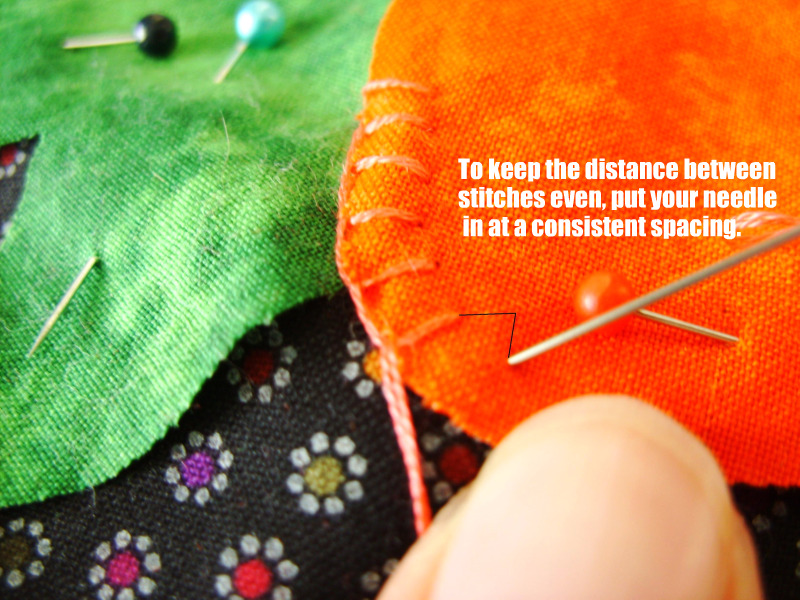
From where your needle just came up, take a stitch down and to the right that lines up with your first stitch into the appliqué. Bring your needle up at the edge of your appliqué and go over the thread you are holding in place. Pull the stitch snug (but don’t make the piece pucker).
This space defines how close together your stitches will be. On smaller pieces, or going around a corner, you probably want them closer together.
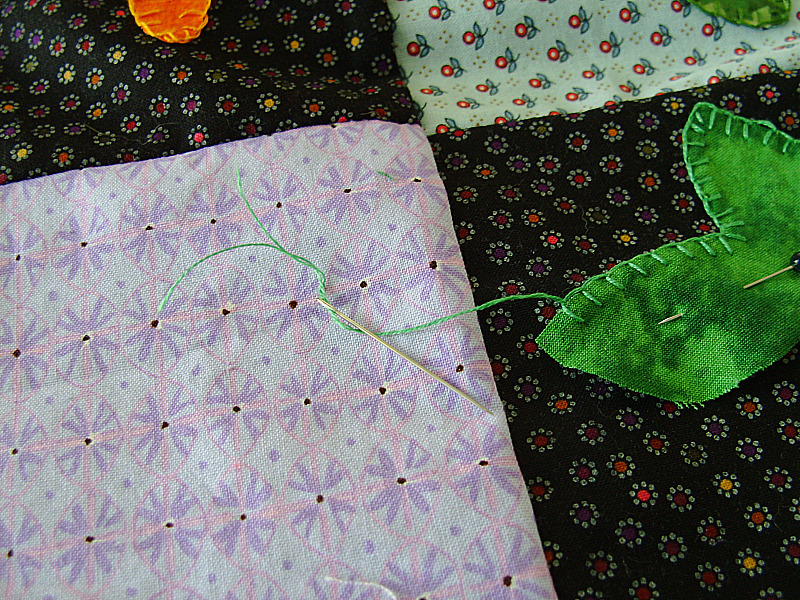
Keep going until you’re done, or almost out of thread! Make sure you leave a long enough tail so you can make a knot on the back.

You can see how I had fun with colour. I used different shades of orange on my carrots. Changing the colours made it more fun to go around so many carrots –- and also gives the up-close viewer a visual treat. The carrots in the border were not fused down, just pinned in place until I secured them with the blanket stitch.

The bunnies and carrots in the quilt top were fused, then stitched. I used bright, fun colours on them too. I used a fairly large stitch on the bunnies so it would be more visible.
I hope this was helpful and encouraging. I stared at many magazine diagrams and pictures of beautiful quilts before I finally tried my hand at appliqué and the blanket stitch. You’ll never know the possibilities until you try. Thanks Kay for providing so many possibilities with your designs and inspiration-packed blog. I’m looking forward to including appliqué on many more quilts.
With Joy,
Sarah Vee
www.sewjoy.blogspot.com
Kay: Thanks a million, Sarah, for your article sharing the joy of appliqué! You’ve gone from “A” word avoider to appliqué enthusiast, because you found your method! I love those patched bunnies… reminds me that I have some randomly pieced hunks of patchwork sitting in the UFO pile awaiting their final destiny! Hmm…
FYI, Sarah is hosting a Placemat Party Blog Hop from Monday, June 28, to Friday, July 2. Visit her blog to find a new hostess each day celebrating the release of Sarah’s first pattern, “Eat with JOY! Placemats”. There will be prizes, fun, refreshments, and hostess-gift ideas for summer parties. Sounds like summer fun!
Until next time,
Kay
By Kay Mackenzie
Jun
2
Fuse a fabulous Cutting Garden
Filed Under Books, Color, Fusible web, Machine appliqué, Prizes, Raw edge, Threads | 30 Comments
Melinda Bula, author of Candy Cane Lane (our featured appliqué book from last August) is a master of fusing realism into her fabulous floral art quilts.


In this visually rich book, the author shares her process for creating colorful, shaded, detailed, realistic flowers in fabric and thread, and encourages us to start with our own photos of the flowers we’d like to render. “I want you to experience the same thrill I get when I create,” she says. “Everything you need to know about making Cutting-Garden quilts is in this book, and even if you don’t feel like you have an ounce of creativity in you, I assure you that anyone can make these quilts with amazing results.”
For those who’d rather start with some training wheels, Melinda includes five patterns to get you going, with easy-to-follow steps and a fabric key to help with color selection.
The book starts out with a gorgeous gallery for your inspiration. The gallery also serves to show the author’s progression through the development of her techniques and understanding of color and depth.

Then Melinda writes about the creative process (stop stomping on your own creativity!) and emphasizes the need for a place to work. Then, on to fabulous fusible appliqué, going through supplies, subject matter, making an outline drawing, enlarging it, creating a color palette, finding just the right fabrics, using the fusible web, making the appliqués, and putting it all together!

Look at all those different subtle colors that went into making white flowers!
Another thing that Melinda is fantastic at is threadwork as part of developing the fabric art. She tells you everything about it, from batting to presser feet (foots?) to thread choices to tension. There’s information on tacking down the edges of the appliqués, then moving on to adding shadows, highlights, and other thread details. (I can testify that this is a gorgeous part of the process, as I was lucky enough to be a quilt holder when Melinda came to speak at my guild, and oooh.)

Visit the author’s blog, Melinda’s Cutting Garden.
I have a copy of Cutting Garden Quilts to give away, courtesy of That Patchwork Place. Leave a comment by 7:00 p.m. on Sunday, June 6, to enter the drawing. U.S. and Canada only please (unless you’d be willing to pay the shipping).
To those of you who are subscribed by email, click over to the blog itself and scroll to the bottom of the post to leave your comment there.
Until next time,
Kay
By Kay Mackenzie
May
25
Alex offers free video appliqué classes
Filed Under Classes, Fusible web, Hand appliqué, Machine appliqué, Photo tutorials, Product demo, Starch, Stems/vines | 2 Comments
I just discovered that Alex Anderson is offering a series of videos on hand and machine appliqué over at The Quilt Show website.
If you’re not already a member you do need to register but no $$ involved, the classes are free. Check it out at the appliqué classroom page and follow Alex through many hand and machine techniques. A great resource!
Cheers,
Kay
By Kay Mackenzie
May
17
Best of World
Filed Under Classes, Embellishment, Fusible web, Improvisational appliqué, Raw edge, Spotlights | 1 Comment
At the Pacific International Quilt Festival last fall, I was delighted to see that a fellow PVQA guild member had won a big whopping prize!

Best of World! It’s a big world, and I was so impressed!
Flower Market, Chichicastenango, Guatemala by Meri Henriques Vahl
You can click on the photo to get a larger view.
I asked Meri to tell us something about herself and her work.
Meri ~
I was born just outside New York City in 1945 to a family which, on my father’s side, has had literally generations upon generations of artists (I have never met a Henriques who wasn’t one sort of artist or another!). I received a BA in Fine Art from the University of California at Berkeley, which wasn’t terribly useful when it came to making a living! Fortunately, my husband does that for us, so I’ve been able to live the life of a housewife and non-starving artist.

Meri
In past years, I’ve worked on building costumes for the San Francisco Lamplighters under the guidance of the brilliant designer Melissa Wortman, and I’ve costumed shows for the now-extinct Bay Shore Lyric Opera Company in Capitola.
In 2006, I took my first trip to Guatemala on one of Priscilla Bianchi‘s wonderful Guatemalan tours, and fell in love with what I’ve come to think of as the ‘Rainbow Country’. My first Guatemalan quilt, ‘Las Mujeres Azules de Guatemala (the Blue Ladies of Guatemala)”, a result of that trip, was just published in Lark Books 500 Art Quilts.
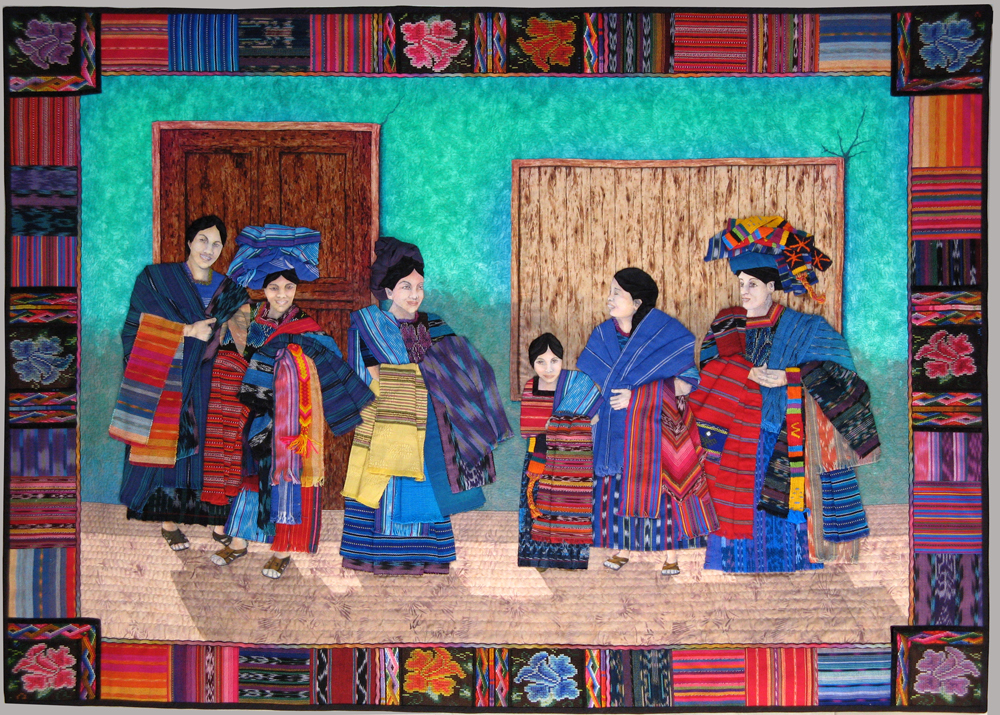
Las Mujeres Azules de Guatemala by Meri Henriques Vahl
I made a return trip with Priscilla in the fall of 2008, and the ‘Flower Market’ (the first quilt shown here) was the result. Here’s a description of my process. I began by putting the quilt back face-down on my worktable. Over this, I spread a layer of natural cotton batting, and then took out my scissors: I was ready to start creating…
The main central picture in the ‘Flower Market’ quilt is a fabric collage using recycled Guatemalan belts and huipiles (woven blouses), Guatemalan fabric, some cotton batiks, and a few flower prints that were cut into very small units. Because I couldn’t find all the flower prints I needed, for example chrysanthemums, I fused cotton fabrics onto Wonder Under and then cut them into narrow strips and ironed them down (just in case I sneezed or the cats got into them!). I also included short lengths of yarn in several places for flower stems, and layers of dark blue tulle (in the flower buckets, for example) to create shadows. Note: there are no seams in this area – it’s all raw edges.
For the faces, I took the photographs I was working from to Kinko’s and blew them up in black and white to the size I wanted, then traced the outlines onto tracing paper, which I then reversed, drawing the image onto freezer paper. Now I had a reversed image.
Next, I ironed fine off-white cotton onto the freezer paper and drew the faces with Aquarelle Caran d’Ache colored pencils using a very interesting layering technique that dates from Medieval times: I first drew the outlines in dark blue pencil, then shaded in the shadows; then came more pencil over-layers of tan, rose, brown, yellow, and black around the eyes. Once I had achieved the effects I was after, I used Sharpie permanent pens to add accents to the eyes, eyebrows, mouths, etc. I also used this same coloring procedure to draw the small baskets and any flowers and fruits I didn’t have store-bought fabric for.
Once my picture was complete, I carefully spread a single layer of black (yes, black!) tulle over the entire surface, added lots of pins to hold the pieces in place, and then spent hours and hours free-motion quilting over the whole thing, to ‘trap’ everything in place. The stitching (finally!) completed, I squared up the picture and then added the borders, using the usual traditional piecing techniques.
I have taught this fabric collage technique in the past, and will be teaching it again at the Monterey Peninsula Quilters Guild on July 11, 2010, and also doing a presentation the next day for the Guild (I believe non-members are welcome to take their classes and attend the lectures). It’s a thrill to see my students take off on their own exciting explorations with this marvelous liberating and fun technique! Since there is no piecing involved, anything goes — and wonderful landscape can be achieved in just a brief couple of hours!
And, I can’t wait to go back to Guatemala and find out what else happens!
Kay here ~ thank you so much Meri for talking us through how your create your stunning quilts. I’ll also look forward to seeing what your next trip inspires!
Until next time,
Kay
By Kay Mackenzie
May
12
Pulling up wool
Filed Under Fusible web, Wool | 2 Comments
I had a question from a reader.
Hello,
Help.
I just started my first wool applique with wonder under and I had to move some of the pieces around after I had adhered them….do I cut a new wonder under and re-iron them or is there some thing else that would work better? Thank you for your help in this project!
Bonnie
I don’t work in wool myself, but my first impression is that pulling up a fused wool motif might stretch it. Kay Moore, who gave us a wonderful and comprehensive article about wool appliqué. reminds me that this very issue is why she doesn’t work with fusibles (along with wanting to keep her wool projects soft and pliable).
Kaye thinks that if the wool applique piece has not been distorted by pulling it off the background, then Bonnie can use it again, not trying to re-fuse it but simply pinning it to the background and stitching. If there is distortion, then Bonnie should start again with a new piece of wool. Bonnie, hope this helps!
Along about the same time I was looking into this question, I noticed a new book about wool appliqué: Penny Rugs: Sewing Wool Applique by Janice Sonnen.

Until next time,
Kay
By Kay Mackenzie
May
5
A Baker’s Dozen of delectable quilts
Filed Under Books, Embroidery, Fabrics, Freezer paper on the back, Fusible web, Hand appliqué, Machine appliqué, Prepared edge, Prizes | 11 Comments
Tasty precuts make great ingredients for A Baker’s Dozen!

A Baker's Dozen from the staff at That Patchwork Place
Most of the staff at Martingale & Company (parent company of That Patchwork Place) are quiltmakers. In this collaborative pattern book they challenged themselves to use the yummy precut assortments available today… we’re talking jelly rolls, layer cakes, honey buns, turnovers, dessert rolls, fat quarters, and charm packs… to whip up a bakery case of delectable quilts.
Note: It isn’t required to use precuts. Each set of instructions also gives fabric requirements for pulling from your stash or from bolts at the quilt shop. But just in case you have been tempted by those luscious jelly rolls, layer cakes, etc., the book gives information on how to handle them, sort them, to wash or not to wash, and what to do about those confusing pinked edges.
Staff from all areas of Martingale contributed to the book, from web manager to the marketing department to customer service and relations, print and production, editorial, book design, illustration, accounting, author liaison, acquisitions and development, and the social networking coordinator, who quilted 11 of the quilts! I thought it would be fun to hear something about the process.
Mary Burns, Marketing Coordinator, tells the story of her quilt Flying Shuttles.

The Editorial Department put out a call to the staff for designs using precut fabrics or fat quarters. I don’t really consider myself a quilt designer. I think of myself as just your average quilter. Everyone here is so encouraging though—I work with such wonderful and creative people—so I decided to jump in!
I had a fat quarter pack of Kim Diehl’s “Country Haven” and I knew I wanted to do something old-fashioned and folksy to go with the décor of my 1901 farmhouse. I found a traditional pieced block called “Cracker” in my trusty Judy Hopkins book 501 Rotary-Cut Quilt Blocks. I set the blocks in circles and called it Colvin Mill Wheels, after a historic mill near my sister’s house in Virginia.
At the last minute, I sketched out an alternate layout of Cracker blocks in vertical rows—and that’s the one that was chosen. (Hooray for last minute inspiration!) At that point the quilt didn’t have any appliqué, but after I pieced it and sewed on the cream border, it just looked like it needed something. I sketched out a flowing vine, some leaves, and folksy flowers. Fortunately, they were thrilled—but I only had a couple weeks before the deadline for finished quilts— and I was scheduled to be at Spring Quilt Market the first week and on vacation at my sister’s in Virginia the second week. What was I thinking?!
As Marketing Coordinator, one aspect of my job is to get everything ready for our booth at Quilt Market. The month up to and including Market is extremely hectic. I stayed up late every night the week before we left, finishing the pieced borders and machine appliquéing all my vines and leaves, cutting out all my folksy flowers and flower centers and packing them all in my carry-on—didn’t want to risk losing it!
I use freezer paper applique on the wrong side of the fabric, with the shiny side up so that I can press the seam allowance to the sticky side, then cut a slit in the back and remove the paper. I machine-appliqued the vines and leaves and hand-appliqued the flowers and flower centers. I finished appliquéing the centers onto the flowers on the plane; it really made time fly!
When we got to the hotel, I laid the quilt out on my bed and figured out where I wanted the flowers to go. Despite my valiant efforts, by the time Market was over, I still wasn’t finished appliquéing the flowers—how naïve of me to think that I could work hard at Market and still have time and energy to finish the quilt! So off to my sister’s house the two of us went, my quilt and I, with a promise that I’d email a photo of the finished quilt before the deadline. It’s kind of fitting that I finished it in all the way across the country in Virginia, near the Mill that originally inspired me to use the Cracker block.
I changed the title of the quilt to “Flying Shuttles” because the way the Cracker block turns left and right reminds me of how a shuttle flies through a loom. When I showed it to my teenage sons at home, the Cracker blocks reminded them of the old Intellivision game, Astrosmash, and the space shuttles that you had to shoot to win. Either way, I just love how this quilt turned out–and apparently I’m not the only one, because the quilt has been chosen to be in That Patchwork Place Quilt Calendar 2011—I’m Miss November!
So there’s my saga, hope you find it amusing. The hardest part about designing a quilt pattern is that you have to write down everything you do, and have it make sense to someone who’s never done it before. Now I know! It’s not as easy as it sounds!
Cathy Reitan, Martingale’s author liaison, set a personal challenge for herself with her design.

Circles and Chains by Cathy Reitan
I have always created with textiles, starting in high school with fashion sewing from patterns and then moving into copying store fashions. As I moved into my 30s and had a family, the focus changed to children’s designs and home dec sewing with a little bit of quilting. With the dawn of children having their driver’s licenses and freedom from being a slave to the car, I began to quilt. You know, the kind of quilting where you plan a project, shop for the items you need, and work on it for significant lengths of time, not just in stolen moments.
I usually use traditional civil war colors and patterns with a lot of hand work. When the opportunity to design a quilt for A Baker’s Dozen came along, I set myself a goal of using colors out of my normal color palette and geometrical shapes that where also not the norm for me. Circles and Chains was the result. I combined the traditional Irish chain block ( just could not completely give up the traditional) with the geometric fast-fused applique circles. I made couple of sample blocks and threw them away because the colors I picked were not strong enough to support the jelly roll I wanted to work with. Back to the quilt store for the brown and yellow solids and another trial block was made. The effect of the deeper color was much better with my jelly roll. I used several colors I love to hate, primarily orange paired with turquoise which is color that I am repeatedly drawn to but matches nothing in my house. Now I just need a child to give up a bedroom so I can decorate with a new color scheme!
Working at Martingale is a great place to inspire creativity and take the next leap of faith because there is always someone to encourage and praise your efforts. There is always someone to bounce and brainstorm ideas with. Of course with so many beautiful samples coming in from authors the list of projects I want to make is always longer than the hours left in my lifetime!
Adrienne Smitke from the illustration department describes the collaborative effort that went into her design.

Ladybugs!
This quilt was a team effort, and I think that’s part of why I like it so much. Not only are the colors and motifs cheerful and welcoming, when I see this quilt I think about all the different elements of its construction and how many different hands helped stitch it together.
While I really like sewing, I love shopping for fabric. I could spend hours browsing either online or in the fabric store through the ever changing rows of color and pattern. It is more often the fabric that helps inspire the kind of quilt or project I want to make rather than the other way around. I had been trying to come up with an excuse to work with Momo’s Wonderland fabric line since its release. While browsing for ideas, I took a closer look at the polka-dot print in this fabric line and discovered that some of the dots were actually ladybugs. Inspiration struck and I knew ladybugs would make a cute and easy appliqué design. To compliment the ladybugs, I pulled three simple flower shapes from the print used in the border.
As a technical illustrator I spend a lot of time working with Adobe Illustrator (a vector drawing program), so it was easy for me to draw the full size applique patterns on the computer. This allowed me to easily tweak and size them as I needed to fit the blocks. You don’t need to be a professional designer to use a computer to create your own patterns. Many computers already come with drawing software, or you can simply Google “vector drawing program” online to explore the many options available. It can take a little time to get used to the drawing tools in these programs, however you shouldn’t be discouraged. Like with any skill, practice makes perfect.
Once the quilt design was complete, that’s when the teamwork began. I knew I wouldn’t be able to finish two complete quilts (my other quilt in the book is “Rose Garden,” page 62) in the time available, but my co-workers came to the rescue. Despite that they were all working on additional quilts of their own for A Baker’s Dozen, they pitched in and each took on a part of the process.
While I cut and sewed the pieced blocks, Karen Soltys worked on the appliqué blocks. Karen has a wealth of great tips for how she made the machine appliqué simple and easy. First she traced all the large shapes on fusible web and then, before cutting any of them out, traced the smaller shapes inside the larger ones. She cut those smaller pieces out of the centers of the larger ones, and fused them onto their contrast fabrics. This not only saved on fusible web, but made the finished appliqué blocks much softer and more flexible.
After all the shapes were fused to their fabrics and then to the white background blocks, Karen machine-blanket-stitched around all of the shapes using chocolate brown machine-quilting thread to add definition to the designs. She recommends using open-toe presser foot so that you can easily see where you’re stitching. In addition, she used a 50-weight thread (“regular” sewing thread) in the bobbin, which required loosening the machine tension a bit so that the bottom thread wouldn’t pull up to the top as she stitched.
Karen handed off the appliquéd blocks to Cathy Reitan, who hand-embroidered the beautiful details for the flower stems, lady bug wings, and antennae before assembling the blocks and borders into a quilt top. Karen Burns, who did the stunning machine quilting on almost all of the quilts in the book, stitched all-over swirls in the appliqué blocks to help the motifs stand out, and then added flowers in the borders reminiscent of the flowers in the fabric pattern. Finally the quilt came back to Cathy, who sewed on the binding and hanging sleeve. It was really thrilling to see how all of the blocks and pieces were assembled into a stunning final product, and to know each of us had a hand in it. Now the quilt hangs behind my desk at work and each day I am greeted by its cheerful motifs and reminded of the teamwork that helped put this quilt together.
I really enjoyed hearing these stories, hope you did too. Martingale has supplied a copy of the book to give away, so leave a comment before 7:00 p.m. California time on Saturday, May 8, to enter the drawing to win this delicious collection of quilt patterns. (U.S. and Canada only)
Until next time,
Kay
By Kay Mackenzie
Apr
27
Sew Crazy after all these years
Filed Under Fusible web, Machine appliqué, Patterns, Prizes, Raw edge | 14 Comments
I had a few blocks left over that weren’t right for my new book for That Patchwork Place. It’s fun to have a pile of untapped potential!
Meet my newest little pattern, Sew Crazy.

Yes that’s right, it’s our favorite little sewing machine kept company by easy crazy-patch borders in a 15 x 15 mini-quilt. I used fusible machine appliqué on this one, but of course you can use whatever method you like.
I’m giving one away, but there’s a condition… if you win you have to make one in the next 6 months and send me a picture for the blog! :) Leave a comment before 7:00 p.m. California time on Friday, April 30, to enter the draw. U.S. and Canada only please.
Sew Crazy is available on the patterns page at By Kay Mackenzie.
until next time,
Kay
By Kay Mackenzie
Apr
20
Mini gifties
Filed Under Fusible web, Improvisational appliqué, Machine appliqué, Raw edge, Show & Tell | 3 Comments
On Sunday night I had a date with four men.
My husband, my father-in-law, my father-in-law’s brother, my nephew, and me! It was a rare occasion that all of us would be in the same part of the U.S. at the same time, and it was a total blast.
I wanted to send the older menfolk home with little quilty tokens for their ladies, both of whom I am quite fond, so on Saturday I set out to make a couple of mini-quilts.

These are about 7″ x 9″. Conceived of, fused, stitched, quilted, signed, and bound, and all done by 4:00 p.m.
The men were crazy about them (it’s funny to see the light bulbs go off over relatives’ heads when they finally gain some small inkling of what it is that you do) and I hope the gals like them too.
Until next time,
Kay
By Kay Mackenzie
Mar
3
Tile Quilt Revival
Filed Under Books, Fabrics, Fusible web, Hand appliqué, Machine appliqué, Needleturn, Prizes | 39 Comments
At the Road to California show in January, I had the excellent fortune to sit at the breakfast table with Carol Gilham Jones and Bobbi Finley. Several friends of mine were staying at the hotel, and they were also friends of Carol and Bobbi, so introductions were made–on a first-name basis–and Bobbi was flabbergasted when I asked her, “Are you Bobbi Finley??” That was a very familiar name to me after years of hanging around with active members of the American Quilt Study Group.
Carol and Bobbi had a special exhibit of their tile quilts in the show. Passing these at warp speed as I did the first time, these beautiful pieces have a stained-glass look, but lighter and airier. Bobbi says that a lot of people compare them to stained-glass quilts, but they’re not. Construction-wise, instead of “leading” applied over the raw edges of the shapes, these shapes are finished with turned edges, and the background is left exposed to create the spaces between shapes.

Tile Quilt Revival: Reinventing a Forgotten Form is Carol and Bobbi’s fascinating, educational, and inviting book that reintroduces this “unique and somewhat obscure” form of appliqué quilt.
Tile quilts are explained this way:
Traditional tile quilts… are constructed with small pieces of cotton fabric appliquéd in a random manner to a white background, leaving a narrow space between the pieces; this white space serves as the “grout” between the tiles or “mortar” between the pavers or stones.
The books starts out with a brief history of tile quilts, with great photos showing examples from the past. Then comes a section on how to make a tile quilt, reinterpreted for today. When I read the following, the heavens opened up and I heard the heavenly choir!
The tile quilt technique, with its large and simple shapes, creates an ideal showcase for bold, contemporary fabrics. Interesting, large-scale prints are will suited for the tile pieces. If you’ve ever found yourself admiring some of the daring prints now available but wondering how to use them, a tile quilt is an idea project for putting them to good use.
Hallelujah! I have a tub of fabrics in my stash labeled “Modern” that has been… well… sitting there.

Now my “daring” prints have a destiny!
The techniques used in the book are so simple they’re ingenious! No need to consider seam allowances, to reverse patterns, or to figure out where to place the pieces. Another really great thing about this book is that it has fantastic appliqué instructions… needle-turn by hand, turned-edge machine-appliqué and fusible machine appliqué too, all expertly explained and illustrated. If you’re reading this blog, you probably like appliqué already, but how about this section where the authors say:
Even if you don’t love to appliqué or don’t consider yourself to be skilled at it, chances are you will enjoy the tile quilt process because it is not exacting. The tile-and-grout form is quite forgiving, and the inevitable deviations from strict uniformity in the grout add to the visual interest and appeal of a piece.
How cool is that?? Get your A-word friends to take a look!
After the appliqué information, there are instructions for several projects with full-size pull-out patterns.

Then there’s a Gallery of Contemporary Tile Quilts. These are fun and inspiring to look at as you see what quilters of today are doing to reinvent the form.

C&T Publishing is graciously sponsoring a giveaway of a copy of Tile Quilt Revival! Leave a comment before 7:00 p.m. California time on Friday, March 5, to be in the drawing. U.S. and Canada only, unless you’d be willing to pay the shipping.
Those subscribed by email, click over the the blog itself and scroll to the bottom of the post to leave a comment.
I wanna start a tile quilt right now, but dang I have deadlines!
Until next time,
Kay
By Kay Mackenzie
Jan
3
Machine Appliqué for the Terrified Quilter
Filed Under Books, Designers, Fusible web, Machine appliqué, Prepared edge, Prizes, Raw edge, Reverse appliqué, Stained glass, Turned edge | 33 Comments
Happy New Year appliqué enthusiasts!
Hey is anybody going to Road to California later this month? I got a call just a couple weeks ago offering me a spot as a vendor and I said yippee! If you’re going to be at this fabulous quilt show and conference in Ontario, California, in two weeks’ time, please come by and say hello! I’ll be in 806.
 Sharon Pederson is a Canadian quilter whom I’ve met a couple times, most recently when she came to give a talk at my guild. If you ever get the chance, be sure to go to one of her lectures because it is a highly amusing experience. Sharon’s book Machine Appliqué for the Terrified Quilter is intended for quilters who (like Sharon in a former life) “refer to appliqué as the A word.”
Sharon says that her book is for those who are attracted to appliqué but feel that life is too short to do hand work. Learning that she could appliqué by machine was what it took to make her a total convert! I’ll throw in my 2¢ worth and add that even if you like hand work, it’s great to throw more techniques into your appliqué bag of tricks.
 Lots of introductory information is given about fabrics, threads, needles, sewing machines, and stitches. Then Sharon takes you step-by-step through two methods: invisible machine appliqué, where the edges of the appliqué are turned and the stitches are unseen, and fusible appliqué, where the edges are raw and the stitches are visible. Reverse appliqué is also covered.
Sharon gives lessons on a variety of machine stitches, including the satin stitch, narrow zigzag, and decorative stitches, plus how to manipulate them in interesting ways. Great closeup photos accompany this information.
 The projects in the book are mostly small and manageable, because after all, “you might be just a little bit terrified about the prospect of machine appliqué, so why further terrorize yourself by trying a queen-size project first?”
If you’re more of a visual learner, you might be interested in the DVD, a separate item. A sample lesson from it is available for viewing on the Martingale website.
Whether you’re terrified or not, this is one great resource for those interested in machine appliqué!
Until next time,
Kay
By Kay Mackenzie
Nov
11
Awesome Asian Teapots
Filed Under Books, Fabrics, Fusible web, Patterns, Raw edge, Show & Tell, Topstitch | 2 Comments
I came across this entry on longarm quilter Nancy Gambrel’s blog, where she shows off her customers’ quilts and the beautiful quilting she’s done on them.
Lo and behold, there’s an absolutely beautiful teapot quilt made by Pat Besenhofer, and I recognize it as being from my Teapots 2 to Appliqué.

What an internet find! Pat and Nancy both graciously agreed to let me use the photos and put up a Show & Tell of my own.

Asian Teapot quilt made by Pat Besenhofer, quilted by Nancy Gambrel.
Pat writes,
This is so cool. My quilt is indeed based on your book Teapots to Applique 2. I would be thrilled to have my quilt shown on your website. And to think it isn’t even bound yet! I’m glad that Nancy and I spent so much time exchanging ideas about the quilting, I think the frame she did works beautifully with the teapots and the corner diamonds.
I’ve been a tea person all of my life, and I get so tired of patterns featuring coffee, espresso’s and latte’s, etc., so I snatched up this book (as well as the first one) when I saw it at the all-the-quilt-books-in-the-world vendor at the Rosemont, Illinois, Quilt Festival a a year or two ago.
This is the first quilt I’ve made with a definite location in mind; it’s going to go in my kitchen. I’ve been second-guessing myself on the pattern, wondering if I should have placed one or more teapots going the other way, or adding a teacup in one spot for a bit of whimsy. I’m happy that you like it as is.
Pat told me that the quilt was done with fusible raw-edge applique. In order to get the teapots facing the ‘correct’ way, she copied the positive images, then flipped the paper to create a reverse image to draw on the fusible web. Pat, that’s just the way I do it. Nancy stitched down the edges of the fusible applique with clear thread.
A beautiful job, both Pat and Nancy!
Until next time,
Kay
By Kay Mackenzie
Nov
2
I’m a Subversive Stitcher!
Filed Under Articles, Back-basting (no-template), Blanket stitch, Books, Fusible web, Hand appliqué, Improvisational appliqué, Machine appliqué, Needles, Patterns, Raw edge | 3 Comments
Writer Dawn Goldsmith invited me to do a guest post on her blog, Subversive Stitchers: Women Armed with Needles.
 Of course I wanted to do that! What a great name, and an admirable spirit! I’m not all that subversive actually, but I am totally armed with needles. I wrote a post about the three main sharp implements in my life, showing a few examples of what I’ve done with them.
Be sure to check out Subversive Stitchers, a blog about the abounding creativity of women who wield all sorts of needles.
Thank you, Dawn, one writer to another. What a treat for me.
Until next time,
Kay
By Kay Mackenzie
Jul
31
Spotlight on Laura Wasilowski
Filed Under Articles, Designers, Fusible web, Raw edge, Spotlights | 4 Comments
 Art quilter Laura Wasilowski of Elgin, Illinois, is a founding member of the Chicago School of Fusing. In fact, she’s the Dean of Corrections.
Kay: To me, the CSOF is more about a state of mind that an ivy-covered institution. It’s standing up tall and saying, “I fuse and I’m proud.”
Laura: The mission of the Chicago School of Fusing is to encourage the technique of fusing to create art work. We know that it is the quickest way to get from that idea in your head to the implementation of that idea in fabric. Fusing gives you endless possibilities for making art.
Kay: Were you always a confirmed fuser?
Laura: No, I started out as a piecer as a teenager but as an adult I wanted to make pictorial art. Fusing allowed me to make those organic shapes so important in picture making.
Kay: The readers are going to want to know what’s your favorite kind of fusible web.
Laura: I use paper-backed Wonder Under #805 (regular weight). The release paper that comes with it is so important in creating fused art quilts. You can use the paper for collage building, pattern transfer, protecting the quilt top, and storing fused elements or large fused shapes. It always releases a fused fabric.
Kay: You prefer to use hand-dyed fabric, yes? You dye your own and also offer it in your Artfabrik store. Tell us why these types of fabrics are better for the fused quilts.
Laura: A hand-dyed or batik fabric works best for these raw-edged fused applique quilts. First, there is no finish on these fabrics so they will adhere better (but wash out the starch in a batik fabric). Most importantly, the color penetrates all the way through hand-dyed and batik fabrics so the edges of fabric elements show the color. A printed fabric will have a white background and you will see that white edge around each cut element.
Kay: You also offer beautiful hand-dyed thread. How can it be used?
Laura: I love hand embroidery with my hand-dyed threads. It adds that extra hit of color, texture, detail, or pattern to the surface that cannot be done with fabric. It draws the viewer closer and brings the quilt to life. These threads can be used for any of the needle arts — crochet, knitting, weaving, needle punch, needle point, couching, machine quilting, and bobbin work.
Kay: How do you finish the edges of the motifs in your quilts?
Laura: They are not finished. Steam-setting the glue keeps the fabric permanently adhered to the other fabrics and batting.
Kay: How do you quilt them?
Laura: I first stitch by hand through just the batting and top layer. Then I free-motion machine quilt through all the layers. My Janome 6500 is a work horse and does beautiful free-motion work.
Kay: You’ve authored two books and a DVD. Tell us a little bit about each one.
 Laura: My first book, Fusing Fun: Fast Fearless Art Quilts, is a great book for new fusing enthusiasts who want to learn as much as they can about the fine art of fusing. There are six projects with variations, basic fusing terms and instruction, a section of binding and display, and a gallery of fused art work by other artists.
 Fuse and Tell Journal Quilts shows readers how to translate their stories or ideas into fabric. From sketches, to photos, to design triggers, each of the six projects helps you make the quilt in the book and tells you how to make your art work using those techniques. The wrapped binding is introduced along with tips on bias fusing, working with cheesecloth, and improvisational design.
 The DVD, Laura Wasilowski Teaches You to Create Fused Art Quilts, has a project from start to finish, a tour of my sewing and dye studios, and a gallery of quilts with commentary. And as the Dean of Corrections I go over the rules of fusing from the Chicago School of Fusing. I also sing the fight song sung by the Iron Maidens as they go into battle.
Kay: You’ve been on Simply Quilts and on The Quilt Show. Were those fun?
Laura: Yes, the hosts and crew made it really easy and inviting. As a ham, it was right up my alley! It was also an opportunity for me to hone my teaching skills and to be able to articulate what I do in a short amount of time.
Kay: I hear you’ve become a Serial Quilter. Tell us about this process.
Laura: I have a tendency to work in a series. I’ll take a theme and make quilt after quilt based upon that idea. For instance, in the blue chair series I have my blue chair reading a book, putting its feet up, down at the beach, and plugged in (the Blue Electric Chair). This way I only have to come up with one idea and can make many versions of it before moving on to the next idea.


Kay: You travel a lot for workshops and lectures. How do you enjoy this lifestyle?
Laura: I enjoy meeting new people and seeing new parts of the world. The airports I could live without, but it’s part of my job.
Kay: What are you working on now?
 Laura: Hand-stitched small quilts (see Betty’s Bloomers #13, above), new patterns, dyeing fabric and thread, preparing for workshops and vending, and keeping my head above water until December when my teaching season ends and I collapse into a puddle of colorful water on the floor.
Kay: You’re a bit of a songbird. Would you care to leave us with the lyrics of one of your compositions?
Laura: Sure, here are the lyrics to one of my favorites:
*A Sewer from North Illinois*
(sung to Sweet Betsy from Pike)There once was a quilter from North Illinois,
She exercised often and ate lots of soy.
But a hot flash it killed her as she sewed her last seam,
They found her there clutching her sewing machine.
So take all her fabrics and pile them high,
Take all her quilt tops that reach to the sky,
Take all her needles and bright colored thread,
I hope that I get them,
Now that she’s dead.
Thank you, Laura, for that inspirational ditty, and for visiting All About Appliqué.
Until next time,
Kay
Quilt Puppy Publications & Designs
Jul
13
Mistyfuse product demo
Filed Under Fusible web, Product demo | Comments Off on Mistyfuse product demo
Sarah Vee ordered some Mistyfuse right about the time we were discussing fusible web without a paper backing. She has checked it out very thoroughly and put up a product review on her Sew Joy blog. Lots of practical tips and hints from her extensive testing! Thanks Sarah!! Great information.
Until next time,
Kay
Quilt Puppy Publications & Designs
Jul
8
Hand vs. Machine Appliqué: A Timed Experiment
Filed Under Articles, Freezer paper on top, Fusible web, Hand appliqué, Machine appliqué, Needleturn, Patterns | 16 Comments
I wrote this article awhile ago. I couldn’t get a magazine interested in it, so
I publish it for you here, because I think it’s quite an interesting proposition. This was before I learned back-basting.
Hand vs. Machine Appliqué: A Timed Experiment
by Kay Mackenzie
For quite a long time I was a hand appliquér only. But when I started designing appliqué patterns for publication, I turned to machine appliqué as a speedier way of creating second and third examples of the designs. After all, machine appliqué is a lot faster, right?
Somewhere along the way I became curious about how much time I was actually saving. I decided to conduct a personal timed study to compare a hand method and a machine method. I used a block from A Spin in the Garden, a pattern I was designing.

The spinning vine block in the middle
is the one I used.
I’ll begin by briefly describing the two methods I compared:
| HAND Traditional needle-turn using bias tape maker, freezer-paper templates, and a tracing-paper placement overlay. |
MACHINE Raw edge, small machine blanket stitch using paper-backed fusible web and a tracing-paper placement overlay. |
I used the same block and the same fabrics for both methods. I did not time the initial steps that were common to both methods, including selecting fabrics, cutting background squares, finding my glasses, gathering all materials, supplies, and notions, numbering the shapes in placement sequence, and assigning the colors on the pattern.
After organizing my thoughts and the projects, I set to work, watching the clock and recording the time for each step. I did one method all the way through, then the other. Here are my results.
| HAND | Minutes | MACHINE | Minutes |
| Trace pattern quickly onto tracing paper to make placement overlay. | 2 | Trace pattern carefully onto tracing paper with a heavy marker to make placement overlay, also serves as reversed pattern. | 5 |
| Using front of pattern, trace a freezer-paper template for each shape except vine. Cut out templates precisely on drawn lines. | 8 | Using reversed pattern, trace a fusible-web template for each shape, including vine. Cut out templates roughly outside drawn lines. Cut away centers of flower and leaf templates. | 14 |
| Iron templates onto right side of assigned fabrics. | 4 | Iron templates onto wrong side of assigned fabrics. | 7 |
| Cut out shapes, leaving a turn-under margin outside template. Clip notches. | 6 | Cut out shapes on drawn line. | 8 |
| Make vine using bias tape maker. Apply thin strip of fusible to back of vine. Trace vine placement onto background fabric. | 6 | ||
| Clean and oil sewing machine, change presser foot, insert new needle. Wind bobbin for each thread color. Adjust blanket-stitch setting, test stitching. | 8 | ||
| PREPARATION SUBTOTAL | 26 | 42 | |
| Fuse vine in place. Stitch vine. Then, one shape at a time, using placement overlay, remove templates and place, baste, stitch using thread to match each shape. | 160 | All at once, using placement overlay, remove paper backing and place, fuse, stitch using thread to match each shape (all of one color is stitched before changing thread). Pull thread tails to the back, knot, and bury. | 91 |
| TOTAL | 3 hours 6 min | 2 hours 13 min | |

Hand

Machine
Click either block for a close-up.
It was interesting to note that the pre-stitching phase took longer for machine appliqué than for hand appliqué. Cutting out the centers of the fusible web templates is not applicable for freezer-paper templates, and ironing time for fusible web templates is longer than for freezer-paper templates. For hand appliqué, I didn’t need to set up my machine, and I could trace the overlay quickly and with less care, since it was for placement purposes only.
The time savings for machine appliqué showed up in the last stage, where the shapes were placed, secured, and stitched. The grand total difference in time represented about a 30% overall time savings for machine appliqué.
There’s a lot to think about when looking at these time results. You may be faster or slower at any of these steps than I am. There are many ways to appliqué, and you may use differing techniques that are slower or faster within either hand or machine methods.
Also worth noting is that when I first took up machine appliqué, I don’t think I saved any time at all, because I made a lot of mistakes. Forgetting to reverse the pattern, neglecting to remove the centers of the templates, having the fusible come apart from the paper backing before I had a chance to use it, fusing to the right side of the fabric (force of habit from hand appliqué), and probably a few other embarrassing ways to get things wrong — mistakes in machine appliqué are not a time saver! Now I am comfortable and practiced at both methods, and the times noted in this experiment refer to a “clean run.”
Time, of course, is not the only factor for choosing one method over another. Personal enjoyment, skill level, preference for appearance, portability, appropriateness for the chosen project, type of sewing machine, these things and more can come into play when choosing an appliqué method.
I’m so glad I decided to conduct this personal timed study. Now I have learned that when either method is equally appropriate for my project, and time is the deciding factor, I’ll be saving almost a third by using machine appliqué.
I’d love to hear what you think about this! Did I save as much time as you thought I would?
Kay
Quilt Puppy Publications & Designs
Jun
26
Ink Jet Printable Fusible Web
Filed Under Fusible web, Machine appliqué, Photo tutorials, Product demo | 8 Comments
More fusible web! I stopped by the June Tailor booth at Spring Market and noticed one of their new products… Ink Jet Printable Fusible Web. They gave me a package to try out.

The package says, “Use any pattern that you create, scan, or download onto your computer.” I would add a caveat… the pattern has to have templates that are separated from one another. The reason is that when you cut out the shapes, you need to leave a little bit of product outside the line, so that when you cut out the fused motif, you’re cutting fusible and fabric at the same time. That gives a clean edge.
Being a designer, I have tons of appliqué patterns on my computer, but I don’t normally design with all templates separate. To try out the printable fusible web, I took one of my simple patterns from Easy Appliqué Blocks, Moon and Stars, and moved the shapes apart. I also reversed them, which is what you need to do for fusible appliqué. (Didn’t need the centering lines just to print the templates, but I forgot to remove them.)


I took all the paper out of my printer tray and loaded one sheet of fusible web per the instructions. On my printer, the printable side is down so that’s how I loaded it, with paper side down. Then I sent the print job. Well, the sheet crept out of the printer slower than a snail’s pace. I couldn’t figure out why, so I checked my print settings… yep, it was set on Quick. Then I remembered that the package said to use a ‘plain paper’ setting. I rechecked my settings and changed the paper type from automatic to plain paper and tried it again. Voila! It printed on out like I thought it should. On automatic, my printer detected that this was some sort of weird stuff moving through its interior and did the best it could to interpret how to print on it. This was a case of RTFM. If you don’t know that term, it’s short for Read the Fabulous Manual. (Sort of.)
Here’s the printed sheet.

I cut the templates apart.

Then cut the centers away.

Fused to the backs of my appliqué fabrics. (Note: the package says to use no steam, and really, you’ll need to use a dry iron. In case you left any of the lines at all, let’s just say that steam and inkjet do not play nicely together.)

Here’s what the glue looks like after it’s been fused to the motif. Kinda shiny-like.

I positioned and fused the shapes to the background fabric. The instructions again say to use no steam. Normally I would use steam at this stage, because my understanding is that that’s what activates the glue. But I used a dry iron, and, after an initial press, “glided” it as the instructions said to do. Worked fine.

I stitched with my usual small machine blanket stitch and all went well. There was no gumming of the needle.

The product performed quite well for me, and acted just as it said it would. Something to think about is that if you mess up a template, it isn’t going to be all that easy to reprint just one template.
And, all this product was left over. That’s not going through my printer again. I guess I’ll save it and try using it in a future project the old-fashioned way, by tracing.

So, if you see June Tailor Ink Jet Printable Fusible Web and you also have appliqué templates in electronic form (original, scanned, or downloaded), pick up a package and try if for yourself! It costs more but you may enjoy the time saved and accuracy of not having to trace your templates.
Until next time,
Kay
Quilt Puppy Publications & Designs
Jun
21
Help wanted ~ fusible web, no paper
Filed Under Fusible web, Machine appliqué, Raw edge | 8 Comments
Just got this comment from Joleen on my Fusible web management post. I’m bumping her question to this new post.
Hi Kay,
I LOVE your site!
I am new to sewing and living in a non English speaking country. I have, due to much hard work and determination, found some sort of fusible web at the local fabric market. I have it in two forms…a small tape ( like scotch tape) and by the meter sheet. However, I am REALLY confused by how to use it. There is NO backing paper…..I would be so grateful for any tips of hints you can give me on how to use this stuff….
Joleen, I think the strippy stuff is like a sewing notion called Stitch Witchery. A ‘tetch’ of this can be useful in appliqué situations where you need just a little strip to tack something down or to effect a repair of some ilk. I have some in my drawer of “things on a roll.”
In past appliqué explorations, I’ve tried using non-paper-backed fusible web, and I’ve always come back to the paper-backed kind. I actually can’t remember how to use the naked web. This is like Misty Fuse I’m thinking. Appliqué enthusiasts, please chime in! Joleen in another country needs your help!
Kay
Quilt Puppy Publications & Designs
Jun
17
Trying a new fusible web
Filed Under Blanket stitch, Fusible web, Machine appliqué, Product demo, Raw edge | Comments Off on Trying a new fusible web
As I was roaming the aisles of Spring Quilt Market with my eye attuned to everything appliqué, I was stopped by a display wall of product. “Fusible Web” jumped out at me. This was the Bosal Foam and Fiber booth and the nice gentleman there gifted me with a package of their paper-backed product for me to try.

Here’s what the fusible side looks like.

I used it to stitch up a new block.
 I’m happy to report that the product worked quite nicely for me. It’s a bit heftier that the Wonder Under that I normally use, but since I cut out the centers of my templates, the finished block was not any stiffer at all.
On a couple of the pieces, the edges of the fusible were wanting to separate from the template, but with careful handling I didn’t have to redo anything. Once fused and cut out, the edges of the motifs were crisp, with almost no fraying. Yay! (Note: this may have more to do with fabric choice than with fusible web choice. I’m just sayin’.)

One thing I like is the really good explanation on the back of the package about the variables involved in getting a successful bond. “Time, heat, and pressure are the three key elements,” it begins, and goes on from there with some very good information about these variables. Note: it refers to ‘interfacing’ throughout, which to my mind is a different product from ‘fusible web.’ Maybe they use the same info on their interfacing packages, or maybe the company refers to fusible web as interfacing? In any case, it’s good information for either.
I contacted the Bosal company to learn more about the product, and received a prompt and comprehensive reply. I’ll just quote most of what Drew Serbin, Director of Operations, wrote me.
“Bosal is pronounced Beau-suhl. Our website is www.bosalonline.com and it is quite comprehensive, including information about all interfacings produced by Bosal Foam and Fiber as well as the myriad other craft products we produce, including urethane foam, bonded polyester battings, polyester fiber fill, and vellux craft kits.
If quilters go to our website and go to the “Where to Buy” section, they will see a list of distributors and high-volume retailers. If they click on the “Map” link they will actually see a map of the United States and can click on individual states to find a retailer.”
I clicked on the Bay area on the map and came up with Beverly’s, which we have right here in Santa Cruz. I’ll have to check it out next time I go.
I asked whether polyamide is the same fusible that’s used on other brands, and Drew told me that yes, it’s the same adhesive that’s used on nearly all fusible web, including Wonder Under. My needle didn’t gum up or anything like that, worked fine.
Drew also sent me some great information about other types of Bosal products. These things are beyond my personal ken but they may be of interest to all you crafty people, so I include the info here. Over to you, Drew.
“I would also add that Bosal has one of the most extensive lines of quilters’ fleeces in the market, including two weights of sew-in, scrim supported fleeces, the heaviest-weight fusible fleece in the industry, plus cotton/wool, Bamboo, Bamboo/Cotton and Soy Silk/Cotton fleece.
In addition to the fleeces, your readers might also be interested in our extensive line of embroidery stabilizers, which are available rolled on board or slit rolls in popular hoop sizes. The embroidery stabilizer line includes three water solubles, two tearaways, two cutaways, and a flame-retardant perforated for childrens’ wear.”
Here’s something that sounds interesting for those of you who make your own garment or handbag patterns.
“About eight months ago we launched Bosal Create-A-Pattern, it is a nonwoven tracing material that is is packed in a 46″ wide by either 5 or 10
yard roll. The beauty of Create-A-Pattern versus Swedish tracing paper or the like, is that it is a nonwoven, therefore you can crunch it up into a
ball and it lays right back down flat. Additionally, unlike traditional pattern papers and tracing papers, these goods will not tear and can be pinned. Thus it can be used over and over again without damaging the pattern.”
Thank you Drew for all of the info. If you are a machine appliquér and you see Bosal Fusible Web, you might want to pick up a package and give it a try for yourself. Another one for your appliqué bag of tricks!
Until next time,
Kay
Quilt Puppy Publications & Designs
Subscribe



